Choosing the right wardrobe door style can affect how your bedroom looks, feels, and functions every day. When comparing sliding vs hinged wardrobe doors, the best choice depends on your bedroom size, available floor space, wardrobe depth, access requirements, maintenance, and overall interior style. Sliding doors move horizontally along tracks, while hinged doors open outward from the wardrobe frame.
For bedrooms in Dubai, both options can work well. Sliding doors are often practical for compact spaces, while hinged doors can be a better choice when you have more clearance and want easier access to the wardrobe interior.


Space: Sliding needs no clearance; hinged needs 50–60cm to swing.
Depth & cost: Hinged is shallower (58–60cm) and cheaper; sliding needs 65–70cm.
Access: Hinged shows the whole interior at once; sliding shows one section.
Durability: Both last 12–20 years; hardware quality matters more than door type.
Dubai climate: Humidity swells MDF and rusts cheap hardware — use moisture-resistant materials.
Room size decides it: Small spaces favor sliding; large spaces can go either way.
| Feature | Sliding Wardrobe Doors | Hinged Wardrobe Doors |
|---|---|---|
| Opening style | Slides horizontally | Opens outward |
| Floor space | Requires less front clearance | Needs space for door swing |
| Bedroom size | Works well in compact rooms | Better for rooms with more clearance |
| Wardrobe access | One section at a time | Wider access when fully opened |
| Appearance | Sleek and streamlined | Classic, modern, and flexible |
| Maintenance | Tracks and rollers need cleaning | Hinges may need adjustment |
| Best suited for | Small bedrooms and apartments | Larger bedrooms and villas |
| Cost (per linear meter) | AED 1,800–4,500* | AED 1,200–3,500* |
| Durability | 12–20 years, depends on hardware quality | 12–20+ years, depends on hardware quality |
| Noise level | Slight rolling sound | Silent operation |
Sliding wardrobe doors move from side to side along tracks instead of opening outward into the bedroom. This makes them useful where floor space is limited.
In Dubai apartments and smaller bedrooms, sliding doors can be a practical option when the bed, bedside tables, or other furniture are positioned close to the wardrobe.
Sliding wardrobe doors do not normally provide access to the entire wardrobe at once. One section may remain covered while another panel is open.
The tracks and rollers also need regular cleaning to prevent dust and debris from affecting smooth movement.
Another factor is wardrobe depth. The sliding mechanism requires additional space at the front of the wardrobe, so measurements should be considered carefully before installation.
Sliding wardrobe doors are particularly suitable for:

Hinged wardrobe doors are attached to the wardrobe frame with hinges and open outward. They provide direct access to the wardrobe interior when the doors are fully opened.
This style can work especially well in larger bedrooms where there is enough floor clearance for the doors to swing without hitting nearby furniture.
The main limitation of hinged wardrobe doors is the space required in front of the wardrobe.
The doors need to open outward, so furniture such as beds, bedside tables, dressing tables, and chairs should not block their movement.
In a small bedroom, this can reduce usable floor space and make movement around the room less convenient.
Hinged wardrobe doors work especially well in:

Sliding wardrobe doors generally have the advantage when floor space is limited.
Because the doors move horizontally, you do not need to keep the same outward clearance required for hinged doors. This can make a noticeable difference in compact bedrooms.
A hinged door typically needs 50–60cm of clear floor space to swing open, roughly equal to the door’s own width. Sliding doors need no swing clearance at all.
For a small Dubai bedroom, consider:
The key is to look at the complete room layout rather than choosing a door style based only on appearance.
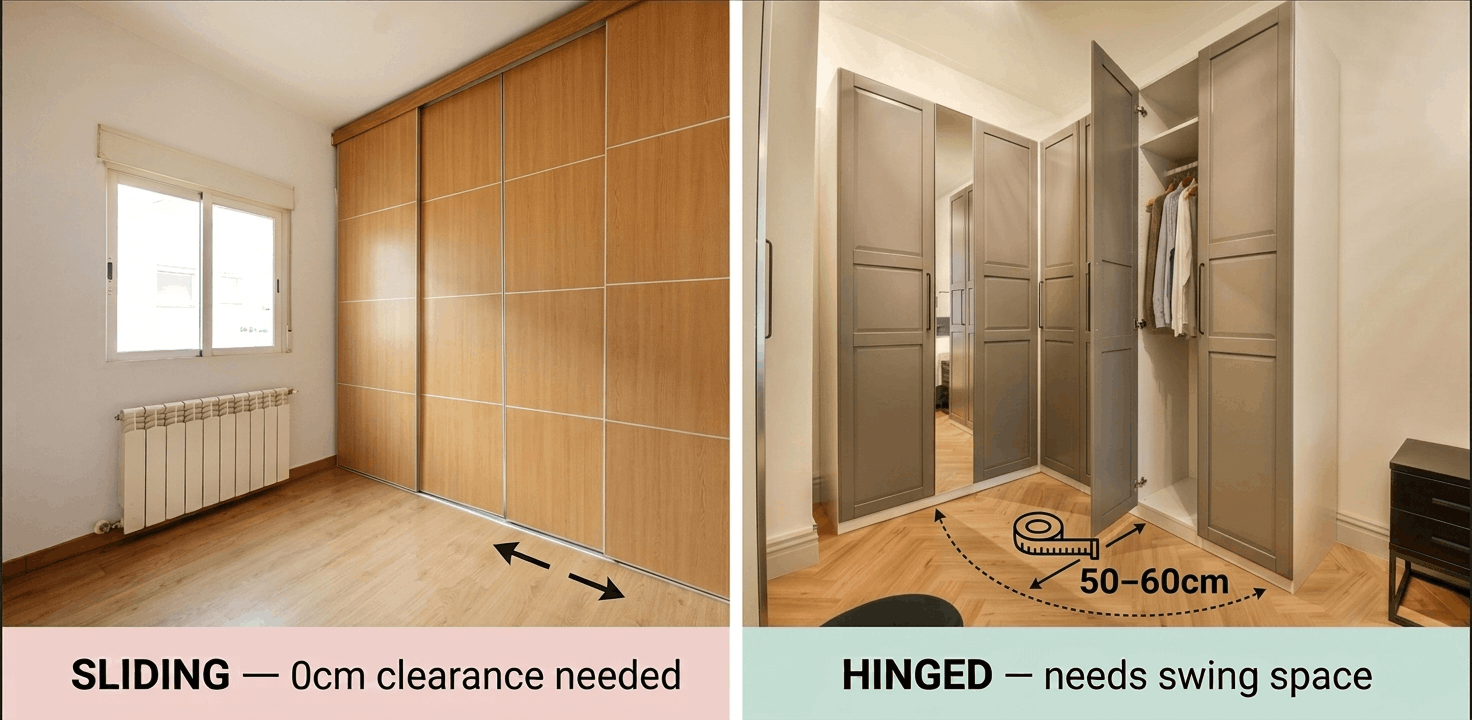
Wardrobe depth is another important factor.
Sliding wardrobes generally need additional depth to accommodate their track and door system. Hinged wardrobes can use a more straightforward cabinet depth because the doors sit at the front of the storage unit.
A hinged wardrobe is typically 58–60cm deep. A sliding wardrobe usually needs 65–70cm, since the overlapping doors and tracks add roughly 8–12cm.
Before selecting your wardrobe, compare the available wall depth with your storage requirements.
For a detailed guide, see our article on standard wardrobe depth, which can help you understand how wardrobe dimensions affect storage and bedroom space.
For smaller bedrooms and Dubai apartments, sliding wardrobe doors are often the more practical choice because they do not require outward door-swing clearance and help maintain a usable walkway between the wardrobe and the bed.
However, hinged doors can still work in a compact bedroom if the room provides enough clearance and the furniture layout is carefully planned.
For small bedrooms specifically, also consider:
Large bedrooms and Dubai villas generally provide more flexibility, with enough floor space for either door style to work well.
When there is plenty of floor space between the wardrobe and other furniture, hinged doors can be a strong option because you can open the wardrobe fully and access several sections at once. Sliding doors are also suitable for larger bedrooms and villas, particularly when you want a sleek, contemporary appearance.
The decision should ultimately be based on the bedroom’s dimensions, furniture placement, storage needs, and design style.
If access is your main priority, hinged wardrobe doors have the advantage.
When several hinged doors are opened, you can see a larger portion of the wardrobe interior at once. This can make it easier to organise clothes, shelves, drawers, and accessories.
Sliding doors provide access to one section while the other door panel remains in place.
Both wardrobe styles can be relatively easy to maintain, but they require attention to different components.
Sliding doors: Tracks and rollers should be kept clean so dust does not interfere with movement. Door alignment should also be checked when necessary.
Hinged doors: Hinges and handles may need occasional adjustment or tightening depending on usage.
Cleaning: Both surfaces should be cleaned with products suitable for their material and finish.
Dubai’s humidity and heat also affect wardrobe materials. Standard MDF can absorb moisture and swell at the joints in ground-floor units or homes near the coast, so moisture-resistant MDF is the safer baseline. Hardware matters too — mild steel hinges and rails can show surface rust within 18 months in low-airflow wardrobes, so stainless steel or zinc-alloy hardware holds up better in Dubai’s climate.
The better option depends on whether you prefer maintaining a sliding track system or a hinged door system.
Both sliding and hinged doors can create a modern bedroom.
Sliding doors often create a more streamlined appearance because large panels provide fewer visual breaks. They are particularly suitable for minimalist and contemporary interiors.
Hinged doors can also look modern when paired with simple panel designs, integrated handles, neutral colours, mirrors, or modern finishes.
Your choice should match the wardrobe design with the rest of the bedroom rather than relying only on the opening mechanism.
Consider these six factors before making your decision:
1. Check Bedroom Size
Measure the room before selecting the door system. Smaller bedrooms may benefit from sliding doors, while larger bedrooms can accommodate either option.
2. Assess Door Clearance
For hinged doors, make sure there is enough space for the panels to open fully without hitting furniture.
3. Consider Wardrobe Depth
Think about both internal storage depth and the space required for the door system.
4. Consider Your Storage Access
Choose hinged doors if you want full access to the wardrobe interior. Choose sliding doors if space efficiency is more important.
5. Match the Bedroom Style
Consider colours, materials, handles, mirrors, lighting, flooring, and other bedroom elements before finalising the wardrobe design.
6. Compare Actual Samples
View wardrobe finishes under your bedroom’s natural and artificial lighting. Materials can look different depending on the light and surrounding colours.
There is no single door style that is best for every bedroom.
The best balance between appearance, storage access, available floor space, and everyday convenience.
Ultimately, the right wardrobe door is the one that fits your bedroom rather than simply the one that looks best in a catalogue.
When comparing sliding vs hinged wardrobe doors, the better choice depends on your bedroom size, available floor space, wardrobe depth, storage requirements, and preferred style.
Sliding doors are often a practical choice for compact Dubai bedrooms because they reduce the space needed in front of the wardrobe. Hinged doors can be better for larger bedrooms where full wardrobe access and wider opening are priorities.
If you are planning a new wardrobe for your Dubai bedroom, Pine Tree Lane provides wardrobe design services to help you plan a wardrobe around your available space, storage requirements, and preferred door style.
Yes. Sliding doors are generally more suitable for small bedrooms because they do not need outward door-swing clearance.
They can be. Larger bedrooms usually provide enough clearance for hinged doors and allow you to take advantage of their wider access.
Sliding doors generally save more usable floor space because they move sideways rather than opening outward.
Hinged doors provide wider access because several doors can be opened at the same time.
They can require additional overall depth because of the sliding tracks and door mechanism. Your wardrobe dimensions should be planned around the available space.
Yes. Both options can work well in Dubai villas. The best choice depends on the bedroom layout, storage needs, and preferred style.
Yes. Mirrors can be incorporated into both sliding and hinged wardrobe designs, depending on the selected materials and construction.


